7 online reputation mistakes you might be making

- 1. Assuming it's not for you>>Assuming online reputation management is only for high-profile individuals
- 2. Not listening>>Not listening to what people are saying about you online
- 3. Not setting goals>>Not setting reputation management goals
- 4. Posting offensive content>>Posting inappropriate or offensive content
- 5. Mixing personal & professional>>Combining business and personal posts in a single profile
- 6. Being invisible>>Being invisible
- 7. Engaging with trolls>>Engaging online trolls
This post has been modified to reflect new information since its original publication.
Because the Internet is where we make our first impressions today, a positive online reputation can open doors and expand your opportunities, while a negative online reputation can limit your choices and cost you financially. As such, it’s vital to take control of your online reputation to ensure it is an asset, not a liability.
Steering the online conversation about your name can be a difficult and time-consuming process if you don’t know what you’re doing. However, you can make the process easier and more effective by avoiding the following common mistakes.
1. Assuming online reputation management is only for high-profile individuals
Movie stars and CEOs aren’t the only ones being googled. Therefore, they are not the only ones to benefit from presenting the best version of themselves online.
In today’s digital economy, individuals and companies are constantly googling regular people, just like you. They then use this information to make decisions about you—and most of the time, you don’t even know they’re doing it.
What they learn about you can determine:
- Whether you get that promotion or that new job
- How much you pay for insurance or a loan
- Whether you get into your first-choice college
- If you’re someone they’d want to date
So, regardless of your popularity or position, it’s worth it to create and maintain a positive online reputation.
2. Not listening to what people are saying about you online

Ignoring what people are saying about you means that false or defamatory information about you can spread across the Internet unchecked. Further, you can’t develop a strategy to improve your online reputation, if you don’t know what kinds of things are appearing in your search results.
To discover the state of your online reputation, you should:
- Search for yourself online—The best way to do this is to perform anonymized searches of different versions of your name. For example, “Jane Doe,” “Jane M. Doe,” “Jane Doe New York,” “Dr. Jane M. Doe.” Be sure to search in a browser you don’t usually use. Otherwise, your browsing history might influence your results. It’s also a good idea to sign out of Google and clear your cache before you start.
Do you have a good online reputation? Find out with our free
Reputation Report Card.
- Write down what you find—Note what level of control you have over each site and whether each site presents you in a good or bad light.
- Assess your reputation situation—Use the information you’ve gathered so far to help you answer these questions about your search results:
- Is my online reputation negative or positive?
- How many top sites do I control?
- What types of sites does my name bring up?
- What are my strongest and weakest areas?
Use what you’ve learned here to develop a comprehensive reputation management strategy.
3. Not setting reputation management goals
It’s impossible to achieve your goals without first defining what they are. This is why it’s so important to create a reputation management plan with specific, measurable steps.
At a basic level, most reputation management plans involve two overall goals:
- Constructing a positive online presence on websites that you control.
- Ensuring that people find these sites when they search for your name.
Here are the specific steps you need to take to achieve these goals:
Get your free
Reputation Report Card
- Identify the search terms you want to target—Pick the words people use most to search for you. Then, consider what kinds of results each pulls up and which terms you can most easily influence.
- Pick a negative result to displace—Start with results that are lower on the search results page because these are easier to shift.
- Choose what kind of content to create and where you will publish it—For example:
- Blog posts on your personal website
- Pictures, posts, and comments on your social media profiles
- Articles you’ve written on document sharing sites
- Create unique, quality content that is optimized for your name—Whether you are writing articles for your blog or creating videos to share on social media, make sure that you are providing value to your readers as this is the number-one quality that will help it rank highly and displace negative content.
- Set a schedule and milestones—Make sure to mark your deadlines on a calendar. Some suggestions for good initial milestones include:
- Attracting at least 20 people per day to your blog.
- Having your content displace a negative result.
- Getting your Twitter profile to rank on page one.
4. Posting inappropriate or offensive content
A key part of establishing a positive online reputation is carefully curating the content you share. If you aren’t giving any thought to what you are posting, then your reputation might not be working for you as well as it could be.
Do you have a good online reputation? Find out with our free
Reputation Report Card.
In fact, you might just be shooting yourself in the foot (metaphorically speaking). For example, you might not get that job you wanted because a hiring manager doing research on you found those posts in which you complain about your previous employer.
It’s always easier to simply watch what you post than to go back and try to clean up your social media profiles. This is because once you post something on social media, it is no longer under your control. Even if you immediately regret your decision and quickly remove the content, it can still exist online if someone had time to take a screenshot of your post before you deleted it. This person can then forward your content to others.
A good rule of thumb is to avoid posting anything that’s controversial, offensive, inappropriate, or hateful—or anything someone might misinterpret as such.
5. Combining business and personal posts in a single profile
Having your professional connections stumble across photos of you holding a red solo cup at last weekend’s BBQ can damage the authoritative image you are attempting to construct. Therefore, you need to separate your personal and professional lives on social media.
There are two ways to go about this:
Get your free
Reputation Report Card
- Create two accounts—This way, you can divide your personal and professional friend lists and prevent anyone from seeing material geared toward the other group.
- Lock-down your privacy settings—By adjusting the privacy settings on each post, you can significantly restrict who can see any personal content. On Facebook, for example, you can use the Basic Privacy Settings & Tools page to alter your privacy settings for current and past posts. This page will also show you how to create lists to limit some posts to a certain audience. You should also tell your friends and family to avoid tagging you in pictures.
6. Being invisible

You might think that it’s safer and easier to remain invisible online. After all, you can’t have any bad search results if you have zero search results!
Although this makes sense logically, having too small of an online footprint can actually be worse than having a few negative items show up in your search results. This is because, by staying mum online, you are essentially letting strangers on the Internet define you.
Do you have a good online reputation? Find out with our free
Reputation Report Card.
While this isn’t always a problem, it can quickly become one when a person with the same name as you commits a crime or posts vile comments that go viral on social media. Then, when someone googles you, they will find links to these other people, thereby guaranteeing that you won’t get that new job or be approved for that loan.
As such, it’s much smarter to be proactive in defining yourself online by populating your search results with content you own. Some ways to do so include posting on social media, starting a blog, or commenting on online forums. These items will ultimately serve as a buffer, protecting your online reputation against any current and future threats.
7. Engaging online trolls
Because of the anonymous nature of the Internet, it’s easy to say things online that you wouldn’t feel comfortable saying to someone’s face. However, you should resist the urge to say unkind or hateful things, even if an online troll starts attacking you. Responding to people like this will not only encourage them to escalate their attacks against you, but it will also damage your online reputation by creating a permanent record of your dispute.
For example, replying to a troll by bragging about your hot wife and fancy car (like this guy did) just makes you seem shallow:
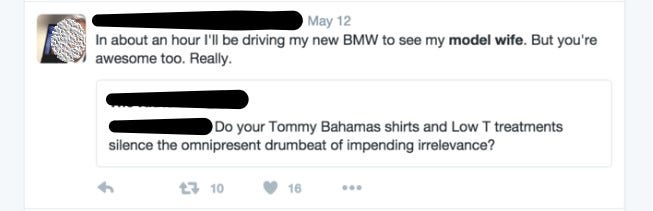
Instead, you should take the high road and ignore online trolls. Block them and delete their comments. They thrive on attention, so the best way to defeat them is to not give them any.
For more information
To learn more about the benefits of creating and maintaining a positive online reputation—or the steps required to do so, see the following articles:
- The definitive guide to online reputation management
- What is online reputation management?
- How to improve your online reputation so that employers will hire you
- How to deal with online defamation
We are also available 24/7 to answer your questions. Feel free to give us a call for a complimentary, no-obligation consultation.
Need assistance? Talk to an expert.
All ReputationDefender consultations are free, confidential, and without obligation.
Call 877-492-5209 or Schedule a Consultation