2025 update: Online reputation management: a primer for dentists

- Claim your listing>>Claim your business listing on review sites
- Monitor>>Monitor what people are saying about you
- Fix your business>>Fix any problems with your practice
- Respond to reviews>>Respond to reviews—both good and bad
- Generate positive reviews>>Generate positive reviews
- Strengthen your brand>>Strengthen your brand
This post has been modified to reflect new information since its original publication.
Nearly 90% of consumers will Google you before doing deciding to visit your dental practice. And if the search results for your name (otherwise known as your online reputation) consist of negative reviews and poor ratings, then people won’t trust you, and thus won’t do business with you. In fact, 57% of potential patients won’t even consider visiting a practice unless it has at least a 4-star rating.
Luckily, the opposite is also true: A positive, professional, online reputation will make people 68% more likely to use your practice. And this will boost your bottom line. According to a Harvard Business School study, each additional star in Yelp a star rating corresponds to a 5-9% jump in revenue.
Therefore, to keep your dental practice thriving, you must ensure that your online reputation inspires trust. To do so, you’ll need to engage in the following reputation management techniques:
1. Claim your business listing on review sites
The first step in strengthening your online reputation is to claim your business listing on third-party review sites. A few of the more popular ones are:
Is online reputation negatively affecting your career? Find out with our free Reputation Report Card.
Claiming your profile on these sites lets you edit your business description to present your practice in the best possible light. It also offers a host of other benefits, including:
- Letting you communicate privately or publicly with your reviewers
- Allowing you to track clicks, calls, and page visits
- Enabling you to interact with customers right from your page
These benefits can not only help you connect with patients, but they can also boost your bottom line. According to a study by the Boston Consulting Group, claiming their business on Yelp earns companies an average of $8,000 in average annual incremental revenue.
2. Monitor what people are saying about you
After you have claimed your business on several review sites, you need to find out exactly what you’re dealing with before you can begin to repair your online reputation. The best way to do this is to read all your reviews—the good as well as the bad.
Try not to get discouraged if you encounter extremely negative reviews.
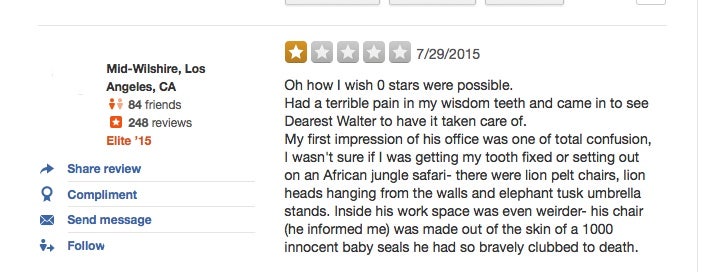
Remember, because of the anonymity of the internet, online criticism is often harsher than it would be if someone were to complain about you to your face. Make a note of the worst reviews so you can prioritize them when you start responding to reviews in step 4.
Your next step is to Google yourself and see what information comes up in your search results, particularly the items that appear on the first page. Besides the review sites, are people talking about you elsewhere online? Are the sentiments mostly positive, negative, or neutral?
To stay on top of what people think about your practice, it’s a good idea to use social monitoring tools, like SocialMention, Google Alerts, and Talkwalker, which will notify you whenever someone mentions the name of your practice online. They all work in a similar fashion. Just type in the term (like the name of your practice) that you want to create an alert for and you will receive a list noting where and when that term appears online.
3. Fix any problems with your practice
Use the feedback you get from reviews and other online sources to improve your practice. If many of the complaints you see are about the same issue (like your billing process, for example), then you can safely assume that these criticisms are valid, and you need to adjust how you run your practice.
Get your free
Reputation Report Card
The next step is to make the necessary changes to eliminate patient confusion and frustration. Once you have done this, you should respond to all reviews and explain any changes you’ve initiated as a result of that person’s complaint. This demonstrates to the reviewer—and anyone else reading the review—that you listen to your patients and care about making them happy.
4. Respond to reviews—both good and bad
Nine out of 10 people read businesses’ responses to reviews, and they will judge your practice by what you say.
The absolute worst thing you can do is to ignore your online reviews. Doing so sends the message to your patients (and potential patients) that you don’t care about them or their opinions.
To prove that you value your patients, you must reply to online reviews promptly. This means responding within 24 hours, whenever possible. And be sure to reply to all reviews, not just the bad ones. People who make the effort to praise your practice deserve your thanks.
When responding to a negative review, be sure to thank the patient for his or her feedback and apologize for the reviewer’s bad experience. Take ownership of the situation. Tell the person how you have resolved the problem (without disclosing any of his or her HIPAA-protected medical information) and promise that you’ll do everything you can to ensure it doesn’t happen again.
An example of a good response to a negative review is:
“Hi xxx. Thank you for taking the time to send us your feedback. We are sorry that you had to wait so long to be seen. Unfortunately, several patient emergencies earlier that day threw off our schedule. Again, we apologize for inconveniencing you. Please call us at xxx-xxx-xxxx and let us know if there is anything else we can do to address your concerns.”
Is online reputation negatively affecting your career? Find out with our free Reputation Report Card.
By resolving your patients’ issues and showing them that you value their patronage, you will earn their trust and possibly turn bad reviews into good ones. In fact, one study revealed that 34% of unhappy customers deleted their complaint after the business responded to it—and one-third went on to post a positive review.
5. Report fake or defamatory reviews
You should flag reviews for removal by the hosting site in the following circumstances:
- When a review is purposefully hurtful and untrue (defamatory): Reviews like this are often posted by someone who harbors some animosity towards you. In these cases, your first step should be to privately reach out to the person and ask him or her to remove the review because these people tend to enjoy getting into a public debate and will escalate their rhetoric if you engage with them. If your private appeal doesn’t work, then you should publicly respond to the review in a polite and detached manner, stating the facts from your point of view. You should then flag the content for removal if the review violates the hosting site’s posting guidelines. For example, it contains threats or foul language.
- When a review is posted by someone who has never been a patient (fake): Sometimes, your competitors, or people who just enjoy stirring up trouble, will write a scathing review of your practice, even if they’ve never been a patient. In fact, a Harvard Business School study found that 20% of Yelp reviews are fake. If you encounter a fake review, you should flag it for removal and then respond publicly, being sure not to insult the person or accuse him or her of anything underhanded. Try to emphasize your commitment to customer service while drawing attention to the fact that you have no record of the person ever being a patient. This way, people will see that you aren’t ignoring the complainer while you are waiting for the review to be removed.
6. Generate positive reviews

Nearly two-thirds of people form an opinion about your practice after viewing just a handful of reviews. Additionally, positive reviews help your business rank higher in local search results, which makes it easier for potential patients to find you. Therefore, you need to make sure that most of your reviews are positive.
Get your free
Reputation Report Card
The best place to ask for reviews is when you are face-to-face with your patients. To help them remember how and where they can post their review, you can put this information on a handy card or flyer you can give them as they leave your office. Other options include sending email requests for reviews and prominently displaying links to review sites on your website.
To automate the review request process, you can also take advantage of professional services, like ReputationDefender Local, which can send out “please review us” requests via a variety of platforms, as well as monitor your reviews and alert you whenever a new one is posted.
When asking for reviews, it’s important to avoid promising your patients money or a discount on your services in return for writing a review, even if you don’t specify that it must be a positive one. This practice violates FTC guidelines.
7. Give your website a checkup
To prevent patients from writing bad reviews, you need to make sure your website is contributing to a positive patient experience. Ask yourself the following questions:
Is online reputation negatively affecting your career? Find out with our free Reputation Report Card.
- Does your practice’s website provide useful and interesting content that visitors are looking for?
- Is this content presented in a simple and logical manner?
- Is the information on the site up-to-date?
- Do the pages load quickly?
If the answer to any of these questions is “no,” then you need to redesign your website to better serve your patients. Otherwise, you are creating a bad first impression before your patients even meet you.
8. Strengthen your brand

Your online reputation is fragile and largely under the control of strangers on the internet. To take back control over what Google associates with your name, you need to start creating content on websites you own. Content you wrote ranks highly in search results for your name, so by constantly adding new content, you can push down negative items on the search results page—thus making them harder to find.
There are several steps in this process:
1. Claim an eponymous domain name
Consider how potential new patients search for dentists, and secure the variation of your name that most people are likely to search for. For example, if you’re Dr. Joe Smith, DDS, of Smith Dental Associates, you may want to grab DrJoeSmithDDS.com, SmithDentalAssociates.com, or JoeSmithDentalAssociates.com. Once you have claimed your website, it’s important to populate it with unique, search-engine-optimized content.
2. Start a blog
Blogging isn’t for everybody, but if you’re looking for a relatively inexpensive way to boost your business’s online reputation, then you should consider writing a blog. For instance, if you write an informative blog post on why flossing is important for preventing gingivitis, you’re offering something of value to your patients and you’re increasing the range of keywords that a new patient might use to find your practice.
Get your free
Reputation Report Card
In addition to blogging on the importance of oral hygiene, you could also take the opportunity to write about updates on your practice. Did you install new carpet in the waiting room? Are you offering CEREC same-day crowns? Did you just upgrade to the latest version of Dentrix? Believe it or not, these are things your patients are interested in learning about.
3. Post on social media
Social media profiles like Facebook, Twitter, and Instagram often rank highly in Google’s search results. To claim this real estate at the top of your search results page, you need to establish social media profiles for your business if haven’t already done so. The next step is to post content that reflects the trustworthy, professional image you want others to associate with your practice.
Social media is also a great way to connect with your patients. You can use these venues to answer questions, post quizzes and contests, promote special deals, and respond to complaints.
4. Carefully curate what you share
Make sure that the content you share reflects the professional image you want to project to others. Before you hit “post,” take a minute to ask yourself whether what you are about to post portrays you and your practice in a positive light. Is this the kind of information your patients are looking for?
Some examples of positive things you can share are:
- Customer testimonials
- Videos of you making a presentation to a group
- Before-and-after photos of work you have done on someone’s teeth
- News stories about your practice
Need assistance? Talk to an expert.
All ReputationDefender consultations are free, confidential, and without obligation.
Call 877-492-5209 or Schedule a Consultation