Putting a price tag on corporate reputation management

- Reputation grows revenue>>How a good reputation can increase revenue
- Reputation hurts revenue>>How a bad reputation can cost you money
- Boost your reputation>>How to boost your business’s reputation
- For more information>>For more information
This post has been modified to reflect new information since its original publication.
“If people like you, they’ll listen to you, but if they trust you they’ll do business with you.”—Zip Ziglar, motivational speaker and author
Trust is the foundation of a business’s reputation. But is it possible to measure the value of trust? How much is a company’s reputation actually worth?
While it’s impossible to put a specific price tag on corporate reputation, there are some statistics that you can use to judge whether investing in online reputation management (ORM) makes sense for your business.
Read on to learn about:
- Why reputation is important
- The financial benefits of a good reputation
- How a negative reputation can cost your company money
- What you can do to boost your business’s reputation
Why reputation is important
Much more than a simple evaluation of how great your products or services are, your business’s reputation is a measurement of how well you communicate to consumers what your brand stands for. People want to know that your priorities are the same as theirs, whether this involves customer service or corporate social responsibility.
These shared connections establish a human bond with your customers, making them more likely to trust you, advocate for you, and believe in you, even when your brand is under attack. This is why a company’s reputation is such an invaluable asset, accounting for 63% of a firm’s market value, according to a study by Weber Shandwick.
How a good reputation can increase revenue
Your company’s online reputation (what people are saying about you on the internet) can have a significant impact on your bottom line. In fact, a 2018 study by PR Week and Zignal Labs revealed that a firm’s reputation accounts for 52% of its market value. Further, University of Technology Sydney researchers recently discovered that consumers were willing to pay more for a product if the company selling it had a good reputation.
Beyond these examples, a positive online image can result in:
Increased brand loyalty
A strong reputation contributes to brand loyalty, and loyal customers (repeat customers) are extremely valuable.
Are online reputation issues hurting your business? Find out with our free Reputation Report Card.
- They have higher conversion rates: According to Paul Farris’ book Marketing Metrics, the conversion rate for loyal customers is between 60-70%, compared with the average customer conversion rate of between 2-3%.
- They spend more: 52% of customers say loyalty programs lead them to spend more.
- They refer you more: Repeat customers are more likely to refer your business to other people. After 10 purchases, they are 50% more likely to tell others about you.
More customers
Businesses earn their good online reputations by pleasing their customers, and happy customers tell an average of 11 people about their positive experiences, according to an American Express survey. Whether they do so by writing an online review or posting their thoughts on social media, the results are the same—free word-of-mouth advertising for your company.
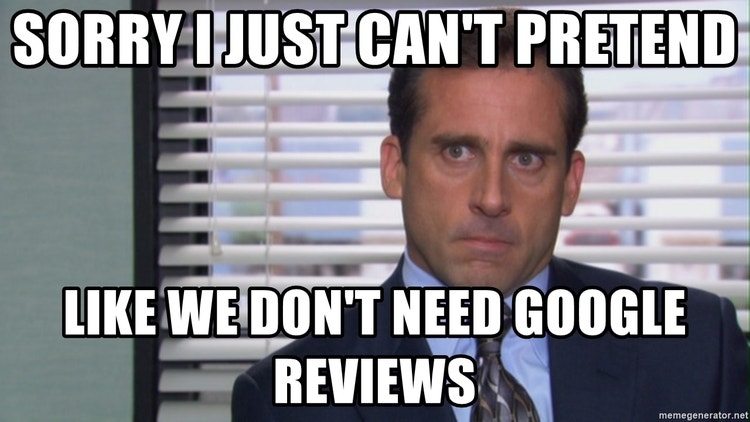
Online reviews, in particular, are a great resource for convincing prospective customers to try your brand. This is because nearly everyone reads (and believes) them, and—more importantly—people change their purchasing behaviors based on them, as these BrightLocal statistics show:
- 86% of consumers read online reviews before buying something.
- 93% of people use reviews to decide whether a local company is trustworthy.
- 91% of 18-34-year-olds believe online reviews are as trustworthy as personal recommendations.
- 57% of individuals won’t patronize a business with less than a four-star rating.
- 68% of people are more likely to buy something from a business that has positive reviews.
- 40% of consumers don’t want to use a business that has negative reviews.
Therefore, a business that has many positive reviews is likely to make more money. In 2016, a Harvard Business School professor proved this when he showed that each one-star increase in a restaurant’s Yelp rating generates a 5-9% jump in revenue.
How a bad reputation can cost you money
Negative reviews and customer complaints can affect your company in several obvious (and not-so-obvious) ways:
Reduced sales
Of course, you can expect far fewer sales if customers decide they can’t trust you based on your business’s negative online comments and reviews. And this can quickly add up to a lot of money.
See your business's reputation the way your customers do. Get your free Reputation Report Card.
For example, the average Facebook user has around 300 friends. Therefore, if you sell something that costs $10, then a low average star rating on Facebook can cost you $3000 in lost potential revenue.
Next, consider the fact that a negative review will likely live on the Internet forever. Assuming that one person a day reads this review, it could drive away 3,650 potential customers over a 10-year period.
One study shows that a single negative post can drive away up to 22% of potential customers. The risk of lost customers jumps to 59.2% if there are three bad reviews. Four or more negative articles raise this number to 70%.
And there’s always the risk of a customer complaint going viral, like the song about United Airlines breaking a customer’s guitar. This customer’s video caused United’s stock to drop by 10%, costing its shareholders $180 million.
Increased hiring and retention costs
A less well-known byproduct of a bad reputation is increased hiring and retention costs. According to a LinkedIn survey, companies with a poor reputation have:
- Hiring costs that are twice as high.
- Turnover rates that are 28% higher.
Hiring costs might be higher for companies with bad reputations because you’ll need to pay more to convince new employees to work for you, according to a study by Corporate Responsibility Magazine (PDF):
- 70% of people would consider leaving their company to work with a business that had a bad reputation, compared to 93% of people who would do the same for a firm with a good reputation.
- 53% of men and 60% of women would require a pay increase to quit their present job and work for a business with a bad reputation. Of these people, 48% would need a pay increase of over 50%.
Brand crises
A bad reputation due to negative press or vilification on social media can have a significant impact on a company’s bottom line. Several recent examples of a poor reputation dragging down a company’s market value are:
Are online reputation issues hurting your business? Find out with our free Reputation Report Card.
- Chipotle: Lost almost two-thirds of its stock value, down from its peak in 2015, due to its E. coli problem.
- Wells Fargo: Lost $29 billion in stock value when news broke about the bank opening fake accounts without customers’ knowledge.
- Samsung: Lost $10 billion in market value due to its exploding phone problem.
- United Airlines: Lost $700 in stock value after dragging a customer off a plane.

How to boost your business’s reputation
Today’s consumers have high expectations of companies they do business with. Before they make any purchasing decisions, customers need to see that a company is:
See your business's reputation the way your customers do. Get your free Reputation Report Card.
- Honest: Telling the truth is always the right call. Your customers will appreciate you being transparent, regardless of whether you are sharing good news, like a favorable review, or bad news, like a hacking incident. Keeping your customers in the dark will destroy their trust in your brand.
- Engaged: Businesses need to be actively communicating with their customers. Sending out the occasional tweet or Facebook post isn’t enough, you need to participate in discussions and respond rapidly to questions or concerns. According to a study by marketing strategist Jay Baer (author of Hug Your Haters) and Edison Research, only 32% of people who complain about a business on social media are satisfied with the speed of the business’s response.
- Socially responsible: According to a 2017 corporate social responsibility (CSR) study by Cone Communications, 78% of people want businesses to address social justice issues. Alison DaSilva, Cone Communications’ executive VP of CSR strategy, says “Companies should now showcase their internal [CSR] efforts to enhance their reputation and gain crucial points in the eyes of consumers.”
To ensure potential customers that you embody these trustworthy attributes, you need to practice the following reputation management techniques:
1. Monitor your online reputation
Before you can repair your online reputation, you need to know what people are saying about you. There are several ways to do this:
- Conduct focus groups: In addition to letting you what people think about you, focus groups often reveal the reasons behind these thoughts. The discussion format also lets you dive deeper into any new issues that come up.
- Send out customer surveys: By repeatedly sending out the same survey over time, you can easily benchmark your data. You can also simultaneously target specific demographics and then filter your results based on a specific variable.
- Keep an eye on your online reviews: Claim your business on all third-party review sites and closely watch for new reviews to pop up. You can automate this process with our ReputationDefender Local product, which automatically monitors online reviews and alerts you when new reviews appear.
2. Fix your company’s problems
Once you have learned what your customers are saying about you, you can take action on their feedback and upgrade any processes that they are complaining about. This way, you remove the reasons for customer complaints and prove that you care about their satisfaction.
3. Engage with people on social media
Customers and potential customers expect you to address their questions and concerns promptly and honestly. To gain their trust, you’ll need to demonstrate transparency and professionalism in all of your social media posts, especially your replies to negative reviews or comments.
Are online reputation issues hurting your business? Find out with our free Reputation Report Card.
Having a presence on social media can also help your business climb to the top of the search results. And by moving your social media content up, any negative content will become less visible because most people don’t look past the first few search results.
4. Invest in corporate social responsibility
Because CSR can increase a company’s revenue as well as protect its reputation, it’s a good idea to make it part of your business’s core business strategy. To make sure you take advantage of all the benefits of CSR, be sure to:
- Show commitment to the causes you support: For example, you could create product donation or employee volunteer programs.
- Be modest about helping others: Showcasing your good deeds can often bring unwanted scrutiny. Phillip Morris, for example, came under fire for spending more on promoting its charitable donations than it did on actual giving.
- Match the causes you support with your expertise: This way, your giving seems more authentic.
5. Implement a social media policy
To ensure that your employees don’t accidentally sabotage your business’s reputation, you should institute a social media policy that addresses the personal and professional uses of social networking sites and defines an employee’s role in both spheres.
Keep these tips in mind when creating your social media policy:
- Employees are personally responsible for what they post and should exercise good judgment before publishing anything online.
- All posts should accurately and honestly represent either the employee or the company while respecting copyright and fair use law.
- Employees must also always protect your company’s confidential information.
- Disclaimers should follow all personal opinions.
- Posts to company sites should be closely monitored, perhaps with an approval system.
- Employees must take care not only to post inoffensive material, but also to post useful material that reflects positively on your company, its services, and its reputation.
When writing your company’s social media policy, be sure to consult a knowledgeable attorney. After the policy has been created, implement it in a clear and comprehensible fashion. Publishing a Frequently Asked Questions (FAQ) document can help avoid any potential confusion.
For more information
Your business’s reputation has many tangible and intangible benefits. If you would like more information on the best ways to maintain your online image, see these articles:
- How to Build a Good Business Reputation: Learn how to promote your brand and respond to negative online content.
- The Definitive Guide to Online Reputation Management: A step-by-step guide to establishing your online presence and improving your reputation.
- How to Remove Negative Reviews from the Internet: How to respond to negative reviews and prevent them from appearing in the first place.
Need assistance? Talk to an expert.
All ReputationDefender consultations are free, confidential, and without obligation.
Call 877-492-5209 or Schedule a Consultation