Internet extortion: How to prevent it and the best ways to respond to it

- What is Internet extortion?>>What is Internet extortion?
- Is it a crime?>>Is online extortion a crime?
- Avoiding embarrassment>>Is there any way to avoid being embarrassed?
- How to protect yourself>>How do I protect myself from online extortion?
- Deleting items>>Is there anything I can do to remove embarrassing items from the Internet?
- How to stay safe>>What else can you do to stay safe online?
This post has been modified to reflect new information since its original publication.
Extortion (paying someone to prevent that person from hurting you in some way) is nothing new. Most people are familiar with this scenario—usually featured in black-and-white gangster films—where a ham-fisted guy in a badly fitting suit offers “protection” to a cowering shopkeeper. When the shopkeeper refuses to pay, the intimidating enforcer says something along the lines of “Think of your family. Bobby, Sally, and little Timmy are nice kids. It’d be a shame if anything bad happened to them …”
While this type of extortion still exists, modern extortionists have adapted their methods to take advantage of the reach and anonymity of the Internet. And because we conduct so much of our lives online, everyone is vulnerable.
This article will discuss online extortion, including what it involves, what to do if someone tries to extort you, and how to avoid becoming a victim.
What is Internet extortion?
Internet extortion often takes the form of blackmail. This involves a threat to expose a person’s embarrassing or damaging information—such as revealing pictures, explicit video, or an aspect of the individual’s personal life that he or she would prefer to keep secret—unless the person gives the criminal what he or she demands. Most blackmailers ask for money, but some request intimate pictures or other items.
And you don’t even need to have anything to hide in order to be targeted for blackmail. According to the FBI’s Internet Crimes Complaint Center (IC3), several different blackmail scams exist. While the specific tactics of each scam may vary, they all contain the following elements:
Has your personal information been exposed online?
- The blackmail attempt is usually in the form of an email from a stranger.
- To make the email more believable, and thus more intimidating, the blackmailer includes some of the target’s personal information, such as a username or password, which he or she probably found on a list of compromised passwords from one of the recent big data breaches.
- The blackmailer accuses the target of doing something most people would want to keep private, like cheating on a spouse or visiting adult websites.
- To explain how the blackmailer gathered the information, the blackmailer usually begins the email with a statement like “I stumbled across your misadventures” or “I installed malware on the adult video site.”
- The blackmailer threatens to send proof of the target’s misdeeds to the individual’s personal or social media contacts if he or she doesn’t pay the ransom.
- The payment window is usually 48 hours or less.
- The target must pay in Bitcoin.
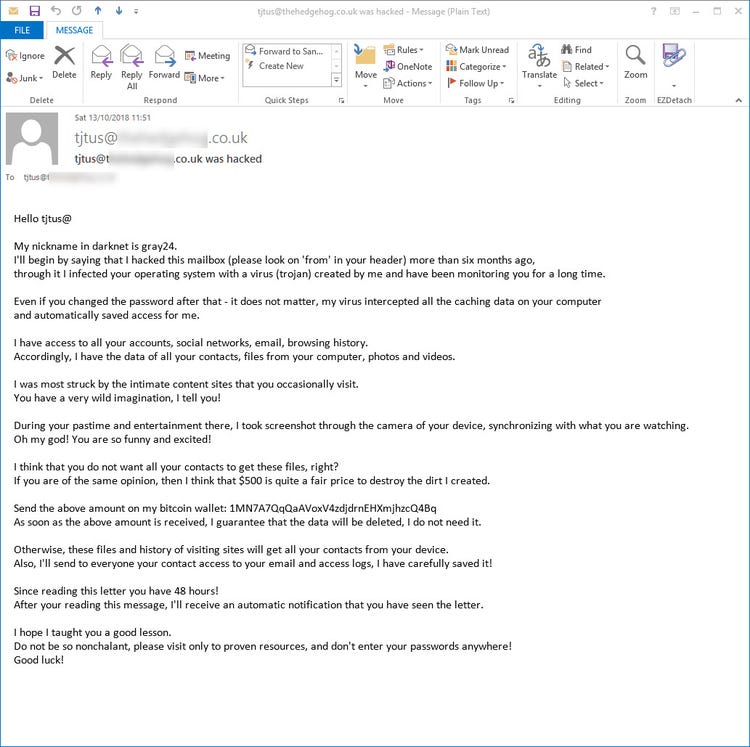
These kinds of scams exist because they work. There are always some people who will pay to keep themselves “safe” from exposure, especially if they believe their computer has actually been hacked. In fact, a Dutch security researcher looked at the Bitcoin addresses in several dozen of these extortion emails and discovered that the extortionists had garnered in excess of $50,000 in just over a week.
Is online extortion a crime?
Yes, extortion is a felony in all states and becomes a federal crime if it involves any type of interstate commerce. To classify as extortion, the incident must include a threat to the victim or his or her property, friends, or family. The threat doesn’t have to involve physical injury or another unlawful act, however. Simply threatening to expose a secret that would result in embarrassment or public ridicule is enough. Many extortion statutes also classify any threat to damage someone’s career or reputation as extortion.
What should I do if an extortionist contacts me?
No matter how much you are tempted, don’t send the extortionist any money. Doing so will only put you on a list of profitable targets, which will increase the number of extortion demands you receive. Plus, there’s nothing to stop the person from asking for more money. After all, you’ve paid once, therefore, you are likely to pay again.
The first thing you should do is to physically disconnect your computer from the Internet. While it’s unlikely the extortionist has the skills to monitor your computer, it’s better to be safe than sorry. Your next step should be to install anti-virus software and run a complete virus scan. It’s also a good idea to install a firewall if you haven’t done so already.
Once you’ve ensured your computer is protected, you should change your computer password and the passwords to all your email, banking, social media, online shopping accounts. Then, take screenshots of the message you received from the extortionist—making sure to include the person’s email address or chat handle. Finally, inform the police of the situation and report the incident to the IC3.
Is there any way to avoid being embarrassed?
It really depends on how your particular situation unfolds. But realistically, you should be prepared for the extortionist to follow through on his or her threat. It’s probably best to discuss the matter with your family or friends as soon as possible. While doing so may be emotionally painful, the people close to you would rather hear the information from you than read about it on the Internet.
How do I protect myself from online extortion?
Everything you do on the Internet leaves behind a “digital footprint,” which unscrupulous people can use against you. Therefore, it’s important to put as little sensitive information online as possible.
Don’t think you’re safe because you only share things with your close friend group. Even if you send a communication or image in confidence, there’s no guarantee that the person you send it to will keep it secret. If you’re not sure whether to trust someone with something personal or intimate, it’s best to err on the side of caution and keep it to yourself. Similarly, don’t store anything on your online devices that you wouldn’t want anybody else to see; this way, you can still be safe if someone hacks your computer, phone, or tablet.
Here are some more tips to protect yourself:
- Don’t open any emails or attachments from strangers.
- Regularly monitor your bank account and credit report for any suspicious activity.
- Use strong passwords and avoid using the same password for multiple websites.
- Never give out any personal information via email.
- Adjust your social media security settings to provide the highest level of protection.
- Before entering any personally identifiable information on a website, check that the site is using “https” or the status bar displays a “lock” icon.
Is there anything I can do to remove embarrassing items from the Internet?
Don’t despair if an extortionist has posted negative information about you online. While you can try to remove the information, it’s very hard to do. Luckily, there are several reputation management techniques you can use to push the negative content farther down in your search results, thus making it harder to find:
Build up your online presence
The best way to counteract negative information someone has posted about you is to create your own content. Because Google values content you produce over things others write about you, the websites you own will rank higher in your search results. As a result, these sites will push the negative items off the first page, which makes it much harder to find (because most people never look past the first page).
Some ways to create your own content are:
- Become more active on social media: Social media posts are often among the top results when you search for someone’s name. If you haven’t already, be sure to completely fill out your profiles on Twitter, Facebook, Instagram, and LinkedIn. Then, start following people and interacting with them. Just make sure that what you post represents the best version of yourself that you are trying to promote, because gaffs on social media can easily undo the hard work you’ve undertaken to repair your online reputation.
- Start a blog: Blogging is a great way to improve your reputation. To ensure Google ranks your blog posts highly, you need to pay attention to quality. This means writing grammatically correct, informative pieces that address issues that your readers care about. You also need to keep to a regular blogging schedule. The more you post, the more impact you will have on your search results.
- Record a podcast: Use this medium to establish yourself as an authority on something. For example, you can answer questions, tell relatable stories, or interview an expert.
Monitor the web for mentions of your name
To know if the extortionist has followed through on his or her threat, you need to be aware of what people are saying about your online. This “social listening” is also a good way to proactively manage your online reputation, because the sooner you learn about a negative comment or article, the faster—and thus, more effectively—you can respond to it.
Here are some tools you can use to automate the social listening process:
Has your personal information been exposed online?
- Google Alerts: You can use this free tool to create automated alerts for any topic on the Internet. After you’ve selected your keywords, you can choose to receive daily or weekly emails that list where your keywords were mentioned.
- SocialMention: Entering your name in SocialMention’s search bar not only lets you see who is talking about you online, but it also gives you an idea of how people feel about you.
- Talkwalker: Like Google Alerts, this easy-to-use tool lets you set up notifications for one or more topics and receive email notifications in real time, daily, or weekly.
- Rankur: This tool helps you track where people are using your name in social media, blog posts, and press releases. You can also receive alerts when someone mentions you in an online review.
What else can you do to stay safe online?
The best way to avoid becoming a victim of cybercrime is to educate yourself about the possible dangers. To keep yourself and your family as safe as possible, check out the following articles:
- How to talk to your kids about social media safety
- The complete guide to removing personal information from the internet
- How to prevent or defend against online stalking
- How to protect your kids when they play online video games
- How to avoid fake Facebook friend requests
Need assistance? Talk to an expert.
All ReputationDefender consultations are free, confidential, and without obligation.
Call 877-492-5209 or Schedule a Consultation