What weblining means for you and your online privacy

- What is weblining?>>What is weblining?
- Why it is complicated>>Why weblining is more complicated than redlining
- Weblining and the law>>Weblining and the law
- How to protect yourself>>How to protect yourself from data profiling and weblining
- For more information>>For more information
This post has been modified to reflect new information since its original publication.
Some business practices make sense—and some don’t. For example, you can see the logic behind smokers having to pay more for health insurance. But what about a business that limits the products you can see or denies you service altogether because of what you do online? Does this make sense, and is it fair?
This practice, known as weblining, has been growing in recent years, fueled by the ease of data profiling enabled by the rise of Big Data. Luckily, there are steps you can take to avoid it.
What is weblining?
Weblining, in a nutshell, is when online advertising algorithms create discrimination. Although weblining employs the same strategies that regular targeted ads use, weblining’s unfortunate results place it in a completely different category.
To understand how weblining works, you first need to learn about redlining, which is where the practice gets its name.
Redlining describes Federal Housing Authority guidelines in the early 20th century that led insurers to deny loans to people living in high-minority areas. The practice, which became illegal under the 1968 Fair Housing Act, also encompassed real estate agents refusing to show houses in white neighborhoods to minorities or other “undesirable” groups.
Has your personal information been exposed online?
However, redlining didn’t just affect housing. It also persuaded retailers to establish their businesses in more affluent areas and encouraged the denial of employment, insurance, healthcare, and other essential services to individuals and families based on their location.
The term redlining stems from the red markings that real estate and insurance professionals would apply to maps to designate “hazardous” areas. You can see an example of this in the Roxbury area of Boston on the map below.
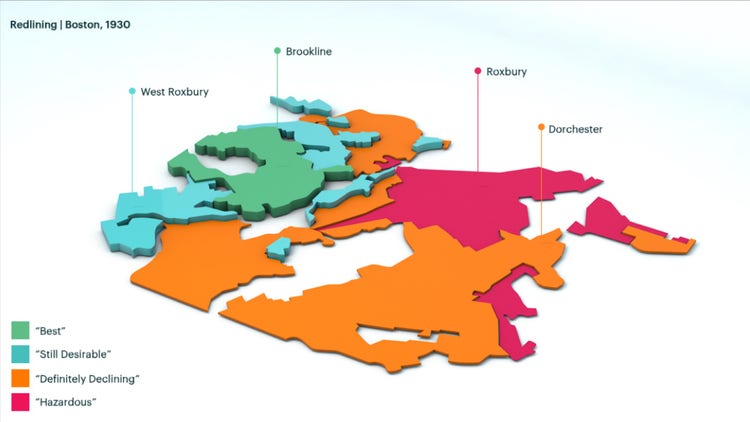
Instead of lines on maps, weblining involves companies using personal data profiles to learn whom they should be advertising and lending to—and conversely who might be a bad risk or not worth the effort. The data profiles they use are created from records of your online activity and can include details like what device you are using, which websites you visit, what apps you download, and which words you search for, as well as your geolocation data.
As a result of these data profiles, companies end up displaying different advertisements to certain groups of people based on several factors. None of this is illegal, and it isn’t necessarily dangerous or problematic either. Essentially, this is how those targeted advertisements end up in your Facebook feed. Problems arise, however, if the data used to display online information is tied to discriminatory bias.
Why weblining is more complicated than redlining
Whereas redlining was a conscious choice based on racial prejudice, weblining discrimination usually happens accidentally and automatically, implemented by online marketing algorithms. For example, if young people whose data profiles indicate that they live in a high-income area routinely receive brochures for Harvard and Yale while their peers across town only see ads for trade schools or the local community college, then these two groups will have unequal opportunities and therefore experience significantly different outcomes.
These inequalities have drawn the attention of civil rights groups like the ACLU, which recently won a lawsuit against Facebook for its weblining practices. According to the settlement, advertisers on Facebook can’t continue to exclude certain users from learning about employment, housing, or credit opportunities based on their age, gender, or other characteristics, such as their interests or groups, that can logically be substituted for those categories (for example, “Kwanzaa celebrators” or “soccer moms”).
Ready to protect your identity & secure your private information?
However, the lawsuit didn’t address another problematic aspect of weblining: how companies can use it to unfairly gouge consumers, based solely on an individual’s assumed level of risk, which, unfortunately, is not always accurate or unbiased. For example, a business might only advertise expensive, high-risk loans to individuals whose location, social media associations, or purchasing habits suggest they might be in a high-risk group (even if they aren’t), while it targets ads for financial products with better interest rates to people whose online data profiles indicate a higher level of creditworthiness. The same applies to ads for rental properties, job opportunities, local store promotions, and life insurance companies.
An early example of weblining used for price gouging occurred in 2012. After viewing data suggesting that people using Apple devices might book more expensive rooms compared to those using PCs, the travel booking site Orbitz started showing Mac users only the costlier rooms, which they then booked. Consequently, Mac users ended up spending $20 to $30 more per room more than non-Mac users.
Weblining and the law
The good news is that people are starting to demand more control over their online information. In 2018, California passed the California Consumer Privacy Act (CCPA). Similar to Europe’s Europe’s General Data Protection Regulation (GDPR), the new law puts greater restrictions on how businesses can collect and use people’s personal information. The new law specifically provides consumers with the following rights:
- The right to prevent the sale of your information.
- The right to sue businesses that collected your data if that data was subsequently stolen or disclosed as a result of the company’s carelessness or negligence.
- The right to remove data you have posted.
Has your personal information been exposed online?
By implementing these new rights, the CCPA will reduce the amount of personal data that’s available for marketing companies and others to construct data profiles with. And smaller your data profile is, the less likely you are to be weblined by what it contains.
As of June 2019, 14 other states have drafted their own versions of the CCPA. Of these, two have been signed into law.
How to protect yourself from data profiling and weblining
To prevent businesses from weblining you, you need to reduce the amount of data they can find about you online. Although this might seem like a Herculean task, there are some simple ways you can make your data less visible to others.
- Don’t share your information in the first place: Don’t give out any information you don’t absolutely have to. For example, when you’re signing up for a service or filling out a profile, only provide the bare minimum. On social media, make sure your posts don’t reveal any identifying information, like your address or where you work.
- Adjust your social media privacy settings: Limit who can see what you post on public forums and social media sites. Set everything to the equivalent to “friends only.”
- Disguise yourself: Avoid using your actual name whenever possible. Instead, use an alias and a temporary or anonymous email address. This prevents people from tying your online activity to your real name.
- Remove yourself from people-search sites: These data-brokers gather information about you from public sources, compile personal profiles about you, and sell these profiles to others. Search for yourself online to see which sites have your info. Then, go to each site and ask them to remove your info. This is often a cumbersome process, but there are tools you can use to automate the procedure.
Ready to protect your identity & secure your private information?
- Turn off geolocation tracking: Your smartphone might be sending detailed information about your physical location to various online services, letting marketers know personal details like where you shop, where you work, and where your kids go to school. To keep your location hidden, turn off geolocation tracking in your phone’s settings.
- Use privacy apps: You can use third-party applications, such as TrackMeNot, to prevent Internet marketers and data profilers from tracking your search habits. TrackMeNot and similar programs install directly on your browser and conduct random searches that act as red herrings for data profiling programs, resulting in a highly inaccurate account of your online activity. Other services, like Anonymizer, ensure your privacy by hiding your IP address from anyone who may be able to trace it.
- Opt out of online tracking: Make sure you disable tracking on Google, as well as on Facebook, Amazon, and other websites you visit. Tracking cookies gather vast amounts of data about you, including where you go online and what type of device you’re using. You can learn how to disable tracking in the following video:
For more information
To learn more about how safeguarding your online privacy can protect you from discriminatory business practices like weblining, please give us a call. We are happy to provide free advice 24/7.
You can also find out more about keeping your personal information private by reading articles in our Resource Center. We offer an entire section on privacy, with articles like the following:
- How to clean up your digital footprint
- How to keep your name off the Internet
- 11 smart ways to protect your email privacy
- How to protect your privacy from facial recognition technology
- How to remove public records from the Internet in five steps
Need assistance? Talk to an expert.
All ReputationDefender consultations are free, confidential, and without obligation.
Call 877-492-5209 or Schedule a Consultation